Thursday, December 16, 2010

A Real Cold Snap


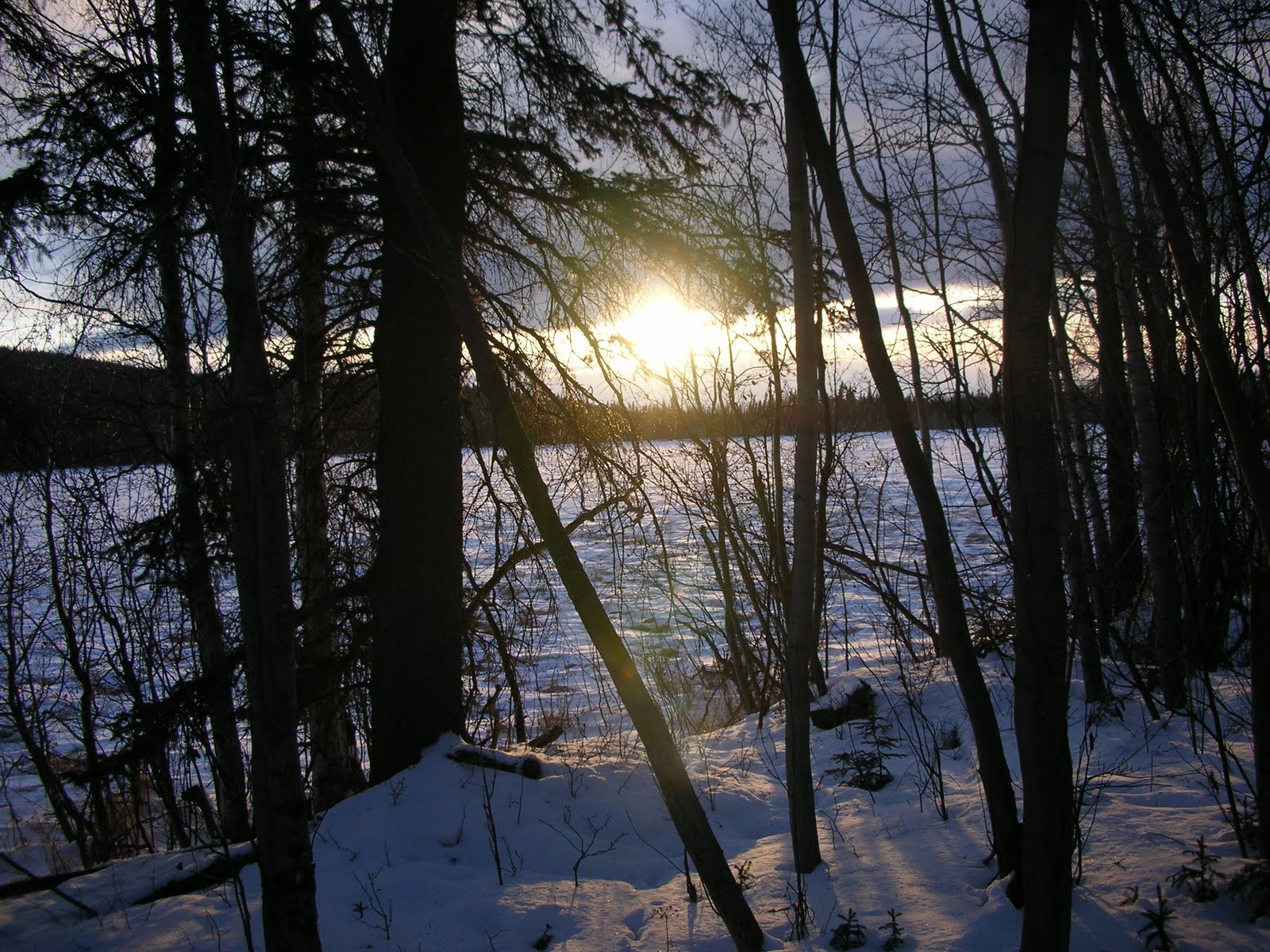
After a mild fall it appears winter is back with a vengeance. Yesterday was in the -40Fs. This morning's temperature was a robust -54F. Needless to say that's cold in anybody's book. Vehicles frequently fail to start even when plugged in. Running equipment just stops operating in its tracks. Snow squeaks underfoot and ice groans on the lakes and rivers. Wildlife hunkers down and the world becomes a very still and silent place in the deep boreal forest. Even the driven actions of modern people turn from commerce and industry to that of warmth and survival.

The night sky is so crystalline clear it looks like you can stir the heavens with a curiously extended hand.

One of the things that makes this place such a special and endearing spot to live.

For folks who have never experienced really deep cold, rest assured that the world fundamentally changes at 86 degrees below the freezing point of water.

Friday, December 10, 2010

Hodgeman's Thoughts on Sarah Palin...


Ok, by now all of my readers have likely seen the above video of Sarah Palin hunting caribou. While I generally avoid politics in my blog I think all my readers can agree that Sarah- love her or hate her- is one of the most polarizing voices in American culture currently. Full length video of her shooting at a caribou has set off something of a firestorm with anti-hunters, pro-hunters and the rest looking to get a lick in. I've heard from several of my readers asking my opinion on the subject and I've read a few other pundits and bloggers giving us their take, both pro and con. I've actually hunted in the Alaska GMU 26 near where these critters were seen. I've also actually hunted caribou which is something most of my Lower 48 readers have not done. As a disclaimer, I have not watched the actual show and I'll try to keep my opinions out of the realm of the political and into the actual hunting events.

So by popular request I'll give you Hodgeman's take on Sarah vs. Caribou.

Much ado has been made of Chuck Heath (Sarah's father) operating the bolt on the rifle repeatedly. While certainly not good practice its not something I'm going to get wrapped over the axle about. As a hunter I fully expect folks to be able to operate their own rifle. As a Dad I know that sometimes you let your kids stop growing at age 8 whether they're 18, 28 or 48. Chalk this up to ambivalence on my part. I'm pretty sure that Mrs. Palin knows how to operate a bolt action rifle whether her Dad is working the bolt or not. I'm more concerned by multiple hands on the rifle and not having negligent discharges and the friend handing the "hot" rifle to Sarah is pretty poor form all the way around.

I also heard quite the hullabaloo regarding the number of times the caribou was fired on and missed. I am fully aware that scopes get knocked ajar and lose zero. It's happened to me in the past and it could happen to any of us in the future. Murphy is all of our hunting partners, like it or not. I'm more concerned that once the plan wasn't working they just kept shooting...and shooting...and shooting. Her form in the video is actually pretty good- not the usual "all over the place" jitters you see with new hunters so she should have been able to call her shots and say- "Give me the other rifle...this one's screwed."

She also asked at one point about the recoil of the rifle. Not that worrying about recoil is at all unusual mind you. I've shot with grown men who worry excessively about recoil at pretty mild levels without it effecting their field performance. What it does show is that she's using an unfamiliar rifle and that's bad. I think hunters should be practicing with their hunting rifle all year long and get to know it like your best friend including dry fire. Someone just taking a rifle from someone and shooting at game is poor form in my opinion although a lot of folks might disagree. Someone with as much field experience as she says she has ought to be hauling out their own beloved smokepole and they know how much it kicks.

One of the bright spots on the clip is the fact she's using a rest for all of the shots. The mantra is "If you can get closer, get closer. If you can get steadier, get steadier." Seeing her use a rest is good form. A real amateur would be blazing away from offhand. I've taught several dozen folks to shoot at this point in my life, I've been a Range Officer, a trainer, and a national level shooting competitor. I just don't get the sense that Mrs. Palin is a total amateur with a gun. I also don't think she's a frequent shooter either but would rather put her in the category- "casual shooter." I totally agree with Jack over at the Locavore Hunter that she shoots like someone who's done a fair bit of plinking with an autoloading .22 LR and very little of much else.

Also much has been said of the fact the caribou appear to be skylined for much (if not all) of the shooting and that's a no-no. Shooting at an animal on the skyline is bad form. Period. I've been on the ground in Unit 26, which is pretty much most of the Arctic Coastal Plain or commonly "The North Slope". I can see how skylined animals are extremely common there since the ground is the flattest I've ever walked. Not at all like the rolling prairies of the Great Plains or the great plateaus of the Southwest. One of my friends in an online posting wrote, "Unless the animal is standing in a hole, its on the skyline up there." True enough but shooting at the skyline is just bad form anywhere. What doesn't come through on the camera is truly how flat the land is and that the hunters could possibly see for an extremely long distance beyond the animal. The camera does strange things turning a three dimensional world into a flat image so its possible the act wasn't in fact as dangerous as it appeared to be but shooting at a skylined critter is a bad deal whether you're in the crowded East Coast woods or the vast empty of the Slope.

Bottom line for me is that Sarah had a successful hunt but I don't think she has nearly the field experience she claims unless much of that experience is following around other hunters in her family and basically doing what she's told. I don't think the clip is remarkably bad as I've seen much, much worse but I certainly wouldn't be calling her a huntress in the class of some of the ones I follow the blogs of- ie. Holly, Kari, Emily, among others. I didn't see the video but I've heard that the family, including Sarah, did a rather good job of recovering the meat from the field and that's a really good deal. Rolling up your sleeves for field dressing and butchering chores is a thumbs up in Hodgeman's book.

Some of the noise I've heard from other pundits is so simply nonsensical I'll address those in brief.

"The meat from this hunt cost $147 per pound." Anyone who thinks hunting big game is an economical way of obtaining meat is an absolute fool. I know Sarah gives a little speech about filling the freezer but that shouldn't be taken to mean that its less expensive than purchasing beef. Anyone whose serious about hunting knows that once you factor in costs, equipment and time- hunting is a pretty expensive way to get meat. I wager if you factored in what she could have been making on the lecture circuit that week, $147 is a pretty low estimate. Successful hunting takes time, equipment and in most of the country- money for travel and logistics. Unless you're potting critters in your backyard with a borrowed air rifle your hunting is going to cost something.

I've also heard much about the behavior of the caribou implying that the animals not running at the sound of gunfire is evidence the event was somewhat staged. The behavior of the caribou is pretty well in line with what I've observed in the field. The chief problem in caribou hunting is finding the animals at all. Once found, approaching the animals is pretty easy. Caribou are not especially wary animals, not generally given to flight until you approach within wolf range. The band of caribou I fired on earlier this year did not flee until we approached on foot to recover the two we shot. Animals in more populated districts tend to move off at the sound of gunfire and internal combustion engines, but caribou in the wilderness will often just stand and look at you while you shoot at them.

After reading this post I realize that this sounds like a defense of Sarah Palin- its not. I feel a bit of transparency is in order on the author's part. I am not a fan of Sarah and I've been a constituent. I've been affected by her policies in ways that are good and bad. I would have loved to have torn into the video with a vengeance and made some hay out of it to further my own personal political view.

But I can't.

When I see the video I see an Alaskan family out harvesting game in Alaska, spending quality time in the field, making some real mistakes, and enjoying some of the real bounty that Alaska has to offer. Sure the actual hunt may be something of a sideshow given the presence of the camera crew and Mrs. Palin's affection for media publicity. But the hunt itself is something my family has done, my friend's families have done and its somewhat representative of Alaska hunting that I love so much. So I can only say- "Congratulations Sarah...nice 'bou."

Apologetics

Its winter again and the weather has me inside looking out at the dark and cold world. Its the time of year when on quiet nights (and most of them are) I can sit and think and wait for the aurora to show itself. Often I read and occasionally write and frequently I'll ponder. In a somewhat unusual move for me, I did pick up a copy of a sporting magazine the other day in the grocery store. I thought it would make good "light" reading for times when I didn't feel introspective enough to ponder or feel mentally engaged enough for a book. One of the themes I noticed over and over in the magazine was a topic that, for lack of better terminology, I'll call "apologetics". Apologetics is generally used in theological circles more than sporting ones but since the definition is "a defense in an argument or debate of long standing". I believe it will nicely describe the situation.


One of the things I noticed appeared frequently is a discussion of sportsman's dollars being funneled for habitat conservation and funding of state wildlife department's and a calculation of the amount of revenue sporting endeavors have on local economies. It also spoke rather glowingly of hunters being a dominant force for population control and game management activities of all sorts. You all know the arguments. You've read them countless times over and over. Dollars. Game Management. Habitat Management. Not that these things aren't true or that its not even a valid argument in the defense of hunting. Its not that its not important. Its darn important in fact.


But it doesn't move me.


I don't arise early and take my rifle and set off to do my part to manage a herd of wildlife. I don't keep tally in my checkbook of how many dollars I spend (too many!) engaged in hunting and fishing activities so I can figure out on an annual basis what my economic impact might have been. I don't shoot wolves or bears for "predator control" and the notion that I'm a dominant force in regulating game populations frightens me more than just a little.

I don't go afield to do any of these things.

Sunday, December 5, 2010

Winter Weather, the Odd November

I realize I haven't posted anything in a couple of weeks. Its because we have been digging out from some of the worst weather I've seen in Alaska in a long time. Our odd winter started when our snow season was delayed by a long warm fall, which is quite unusual in the Interior. We usually go from early September to the deep freeze in late September. Not this year- persistent warm weather and a lack of snow had us all wondering if Al Gore just might be right after all...

By the first week of November we had only a scant covering of snow and temperatures still in the teens. It was still quite warm by mid November with some more snowfall but nothing like we usually have. As a reference point; I've seen Halloween at -30F and Thanksgiving temperatures of -20F are generally expected here. The week prior to Thanksgiving week we saw some below zero weather and things looked to be tracking colder when we got a weather alert from the good folks at NOAA. The forecast was something unbelievable- rain. I'm quite used to seeing my last rain in September.

As a reference for my more tropical readers, Alaskans prefer the cold dry winters the Interior is known for. It may be -20F and snow everywhere but the snow doesn't adhere to anything- even itself. Some of the finest powder you'll find anywhere. Roads are clear and walkways easily shoveled with a minimal amount of ice. A rainstorm where the air 33F and everything on the ground is below zero is a recipe for disaster.

The rain began to fall Thanksgiving week on a Monday afternoon and by Wednesday everything was coated with 2" of hard glaze ice. Road travel was dangerous and many families cancelled Thanksgiving travel. The ice had another expected result- power lines fell and we saw outages across the Interior. Trees fell and blocked roads and trails of all types interrupting ground travel and private aviation just stopped. To add insult to our injuries, immediately following our ice storm (which set all kinds of odd weather records by the way) our temperatures plunged into the -30Fs and stayed there for a week.

Brrr.

Sunday, November 21, 2010

Something New.


I've got to admit I was skeptical about trying the clothing prior to my last hunt. As I've written in the past, I'm a pretty dedicated wool, canvas, and leather kinda guy when it comes to outdoor clothing- you know stuff that will hold up to a fire or a sharp rock. I also fully recognize that some of these polymer miracle fabrics do offer the user performance enhancing perks but I'm not running a race, I'm on a hunting trip. As my friends at Empire Canvas say- "I measure things in seasons, not kilometers." So fully cognizant of my historical position on such matters as long chain polymers and "wonderflage", my friend and sometimes hunting partner pushed me toward a product made by a company called Sporthill.

Image from Sporthill's website.

My friend is not only a cross country skier and biathlon shooter (which is his likely introduction to the stuff) but an accomplished mountain hunter as well. I fully realize that my traditional garb is not particularly water friendly. At the time we were planning a vessel based hunt in rainy and wet Southeast Alaska coastal mountains. So it was with some trepidation that I dropped the (considerable) coin to purchase a set of the Sporthill "Expedition Camo" pants and jacket to try on a couple of hunts. After some field use I can report the following impressions.

First off is that I'm ambivalent on the camo- but I'm ambivalent about any camo including this one. Although I thought this stuff looked awfully dark, photos of me with a caribou I'd taken shows that it blends in fine. If not to the eye then by the result. I don't expect to wear it to town or the office however and I kinda wish they made it in different earth tone shades. This stuff is seriously comfortable and I'm sure I'll get some more of the skiing clothing to use for winter skiing around town. Heck I might just start skiing in head to toe camo given my natural thriftiness (usually called "cheap" by my spouse). I wouldn't be the first in town to do so.

Second is the lack of ridiculous claims put out by the maker. The only two claims they make is that the fabric is made from some of the most hydrophobic yarn on the market and the weave is tight enough to be windproof to 35 MPH. Its not supposed to be waterproof- only exceptionally fast drying after water exposure. I tested that claim after I crossed the Gulkana river with a hole that exceeded my hip boot height (just love it when that happens) and managed to soak the pants pretty thoroughly. I shook them out and put them back on and in a half hour they were basically dry to the touch from wind and body heat. I also hunted in a stiff breeze that hovered near freezing most of the following day without feeling any ill effects of the wind which was nice. It was refreshing to not be disappointed in ridiculous claims like "waterproof and breathable" which is something of two lies for the price of one in my experience.

Third is the comfort and quiet factor. These things wear like my pajamas. Total freedom of movement and noiseless on brush. This is perhaps my favorite attribute about these things- the most comfortable clothes I currently own. This is where the company shows its competitive skiing roots (they also make Olympic uniforms for various winter activities for those of you going next time). Not that I'm a serious athlete but as an avid recreational XC skier these guys would make some excellent ski gear for most conditions. I can easily see how you could be sweating hard, moving the moisture to the surface, and evaporating it off very quickly. As soon as we get some decent snow base I'm going to check that out.

Now for the bad. This stuff is a niche second line product made by an already niche company and it shows in the cost. I paid something on the order of $250 in Fairbanks for the set and thats a nice chunk off retail if you check their website. Thats a lot of coin for a single task item of clothing unless my advancing age and "natural thriftiness" are showing through again. Although comparable to what hunting clothing from other manufacturers costs, I'm not impressed with their pricing structure either. Maybe it is my natural thriftiness but for those of you with disposable income and hunting in wet and cool weather you might consider Sporthill on your short list. If you're a warm weather hunter in arid climates I'd pass- these things would be too warm.

The biggest negative to me is that this fabric is very heat sensitive. Not only will exposure to a campfire be detrimental but a trip through the clothes dryer will be as well. I guess you don't get something for nothing.

Monday, November 1, 2010

Hitting the Ground

Allow me to draw you into a scenario a little bit. You've been hunting the Alaskan wilderness for a couple of days now in the early season of mid-August. You're at least a day or so from the nearest road and at least a day from anything that resembles civilization. Its unseasonably hot in the low 60s and maybe hitting a high of 70 at solar noon. The bugs are not too bad this year which means they won't drain a small dog in less time than it took you to read this far into the narrative but you're not going to sleep in the open either. Otherwise you seriously contemplate DEET poisoning as a possibility.

You look into the binos that have chaffed your neck for two straight days and there, just ambling out of the treeline is what you've been looking for- an honest 50" moose at a reasonable distance to launch a stalk. You launch your bid and a half hour later culminate your efforts in the silence between the thunder and the echo. Your comrades (and I do hope you have some along given what a bull moose weighs) pose for photographs with you and your marvelous hard won trophy but little do you realize that deep within that mountain of animal protein a complex biological chain reaction has just started taking place. The timer was tripped the moment this magnificent creature hit the ground and you have no idea how much sand is in the hourglass. Your next efforts in the field will not stop the sand but your actions can slow down the trickle of the grains allowing you to harvest all of this meat and get it safely home to grace your table and fill your freezer.

First things first- by all means pose for those photographs but please keep them tasteful, respectful and don't dally around about it. Once the eye glazes on the animal the photo will look bad- trust me on this. I could digress into a mini-tirade about trophy photo do's and don'ts at this point but I'll pass since we have more important matters to attend to.

That animal lying there is still at approximately the same temperature he was when he was alive and like all mammals has a whole host of wee beasties living inside him. Just because your well aimed bullet ended the bull's life doesn't mean those wee beasties were harmed in the slightest. In warm weather the stomach will start to distend as the flora of the gut continue to thrive upon your quarry's last meal and produce gas as a result. Now that your quarry is no longer farting subconsciously- that gas is building up pressure. Nothing is more difficult and fraught with potential disaster for meat care like attempting to field dress a bigger critter with a drum taught distended gut. So while your buddy puts away the camera, don your gloves and get out the gut hook before its really unpleasant. A lot of folks attempt to put off this step because it really is unpleasant but waiting will not make it more so and the "field dressing fairy" is away on other business. So please- using any method you find convenient, gut that critter.

And while you're gutting that critter do take all care not to rupture things you might find in there- namely the colon, bladder, and the ever expanding stomachs- you don't want any of this stuff on your plate. If you've been practicing your marksmanship and field skills properly the lungs will have been shredded as possibly is the heart. What that means is that you should have an enormous amount of blood in the carcass rolling about. Don't get freaked out but don't dawdle and get that hot blood out of the carcass right after the organs. As an aside, once you dress out a couple of critters that have been gut shot and determine that you'll have a mixture of blood, gastric juices, food matter and (God forbid) fecal material floating around in your carcass you will for darn sure practice your marksmanship in the off-season. This is where the phrase clean comes in but more on that later.

If all that came off right you will have a carcass minus the entrails but still wearing its fur and head. Back on Grampa's farm this is usually where the tractor or the pickup comes rolling up and you load the critter in the truck in the late October frost. But this isn't Grampa's farm- it's the backcountry of Alaska and Grampa's truck isn't coming. That marvelous fur coat your critter is wearing is keeping all that heat in the muscle tissue where a whole host of other wee beasties is starting the process of decay. Those wee beasties are also reproducing and the only way to stop them is cooling and the next step in that process is to get that fur jacket off.

There is more than one way to skin a moose but all of them entail a lot of moving big pieces, heavy lifting and awkward cutting so be careful. I like to take a tarp to spread out on the ground by the animal to lie pieces on and ensure meat doesn't fall on the ground. A real savvy hand can use the moose's own hide to this effect but a $9.00 tarp will work better. With a smaller animal you may be able to hang them whole for the skinning process but moose are too big and caribou tend to live on open tundra devoid of large trees so you'll work on one side, flip, then repeat. Another word about cleanliness- try to keep hair off the meat. Not only is loose hair stuck to meat a real pain when you butcher- it is also generally filthy given what animals will roll in and stomp in during the course of the day. Don't get freaked out by it but do make an effort to prevent it.

After several minutes ( OK a half hour or more) of this you'll have a side stripped clear of hide. Gather up some game bags (also called quarter bags some places) and get them ready. They should be clean and freshly laundered and prepared to have meat placed inside them. Bloodstained is a good sign they've been here before and are thus "experienced" but dirt covered is not. Remove the leg below the knee joint and cut of the quarter at the ball socket on the rear and shoulder on the front. Given the temperature you've undoubtedly attracted a number of flies and other insects by this point. Prior to bagging, spray the meat down liberally with a citric acid solution produced for such a purpose. This does a few things- it changes the PH of the meat's surface and retards bacteria growth, it slows or stops fly larvae development and it promotes "crusting" (that protective layer that forms on meat as the outer layer of meat dehydrates and the proteins leach out. This hardens into a layer on the surface. With a treated quarter placed in a clean bag then you should hang it up to promote airflow around it. Alternatively, place it upon brush so that air flows under it.

By the time you do this for four quarters on a bull moose, you'll certainly be aching and ready to take any shortcut you can. Don't fall prey to such temptations as you'll be rewarded for diligence later. A lot of folks will start boning out the neck and ribs at this point but I'd suggest not. Boned out meat has a lot of cuts and each cut is a potential place that foreign bacteria enters the tissue and promotes spoilage. A ribcage on bone can last several days under some pretty harsh conditions before spoilage sets in but a bag of boned out meat might not make the next sunrise before its turned. Not only that but meat attached to a boned structure (despite weighing more) carries and transports easier than a heavy bag of formless meat that's as impossible to strap down as a water balloon. If you bone out anything the neck meat should go into the "burger bag" where all the odds and ends pieces go but keep them as large as possible. On caribou I generally prefer to haul out the neck whole- a lot of the neck meat is simply wasted if boned out in the field.

So after several hours of backbreaking labor you should have (hung on a pole) 4 quarters, 2 ribcages, a neck, a burger bag, and a bag containing your tenderloins and backstraps hung on the meatpole. The savvy hunter will break camp and depart for civilization immediately but certain circumstances may prevent this (such as air taxi pickup). Rotate the meat in the bags to help promote even crusting and examine the meat at least twice a day and while you're at it- hit it with citric acid solution again for good measure. If it's very warm you might have reconsidered your shot but in case of hot weather submerging your meat in a creek while sealed in a plastic bag may be your only option. Be careful as waterlogged meat is ponderously heavy and very prone to spoilage. Your meat cache should also be protected from sun and rain while getting good airflow. Keep the meat dry.

So the basic rules are clean, cool and dry (where have you heard that before). Some additional thoughts are:

Cool the meat as quickly as possible, on cool weather hunts this is usually no serious problem but during warm weather the core temperatures of large pieces of meat can remain dangerously high for hours; promoting bacteria growth and early spoilage.

Keep the meat from freezing on cold weather hunts. Meat that has frozen in the field will be tougher than the boots on your feet. Those wee beasties working the meat to spoilage are also working it to tenderness. In the beef industry its known as aging but a deep freeze the first night brings it to a halt- particularly in small pieces or meat off the bone. A large quarter can sustain substantial low temperatures without freezing for a surprising amount of time. This process is known as cold rendering. It is something to avoid.

Keep the meat out of the sun. Direct sunlight can heat up the meat and prevent cooling.

Keep meat in the air. I once saw a photograph of a couple of float hunters who had ingeniously wrapped their meat in a blue tarp to keep it dry and I'm sure it worked great to that end. It also kept it a warm, moist mess and spoilage set in the first day. Do what you can to promote airflow around all the pieces. If you use heavy bags you may want to use cool and bug free periods (like during a good breeze) to remove the bag and let the wind blow directly on the quarters.

Use good game bags. I like heavy canvas bags that are durable and will stand up to sharp bones and heavy loads. Draw backs are sheer weight and size. A popular brand of lightweight game bag sold here tends to explode on contacts with pretty much anything and has a weave so generous that even the Jenny Craig flies can get through to work their heinous craft. These should be avoided at all cost unless you have a preference for dirty, maggoty meat. A new, lightweight synthetic gamebag is on the market that may proved the best of the breed for foot hunters but I haven't tried them yet.

Don't be afraid to pass an opportunity if the conditions aren't right. I passed on several caribou this year during some unusually hot and buggy weather. It would have made getting the meat out of the field precarious at best. I waited for a breezy day that hovered at freezing and was rewarded with perfect conditions to harvest my caribou without worry about spoilage or insects. The reward of taking an animal is the meat you carry home and to waste it is shameful in deed and may be criminal in certain jurisdictions.

So there you have an overview of field care of game meat. For a more detailed discussion I'd like to point you to my friend Larry Bartlett's excellent video- Project Bloodtrail as well as some of his other work that deals with proper field care of game meat in a wilderness setting.
Friday, October 1, 2010

Making Meat

The caribou appeared unexpectedly on the adjacent ridge and I eased forward into a prone position. Bill raised his hat in the air slowly and began to wave it ever so slightly. I tightened the grip on the forend and slid my hand toward the front until the hasty sling went taught. I was locked in and found the middle bull in the 6X scope. The crosshairs were moving more than I liked; I was breathing heavily after wading the river and sprinting up the reverse side of this slope in an effort to intercept the small band of caribou. I focused on the bull and took up slack in the trigger...

The adventure had began a couple of days prior. Hunting season had been in full swing for a few weeks and although I had spent considerable time afield and even saw several acceptable animals, the weather was simply too warm for decent hunting. An unseasonably hot fall in the Interior had rendered the animals sluggish and clinging to the higher peaks and meadows. Several acquaintances had been successful in the early season only to have their success turn into a hellish race against heat and bugs to prevent their hard earned meat from spoiling. Game wardens had been citing large numbers of people for wanton waste when they returned from long trips with quantities of spoiled and inedible meat. Just the previous weekend, Evan and I had battled gnats and biting flies in the Tangle Lake district and stalked a small band of caribou. We gave up on a serious pursuit when the temperature passed the 80 degree mark by midday. The weather forecast had record highs for several days in a row and higher than normal temperatures were forecast for the near future.
I was contemplating the coming weekend on Wednesday when my friend and frequent hunting partner Bill stopped in my office. "This is the weekend", he declared,"get your gear together and we'll pick you up on Friday. Plan to be back on Sunday night. I'll fill you in later." With that brief phrase he spun and left the office on some other unknowable errand. You see, Bill is an unusually successful and frequent hunter who's been in these parts for a long time now. I generally find it wise counsel to listen to his advice when it comes to harvesting game. The office door hadn't even shut by the time I was dialing the phone to tell my wife that I was going hunting for the final weekend of the early season caribou hunt.
Friday came and after work I had my gear all packed for a warm weather hunt. Bill and another hunter stopped by and we chatted briefly as we loaded my gear into the truck.
"Where we going?" I queried.
"Dickey Lake... and better bring your winter gear." was the reply.
I felt a little odd packing my winter gear into a duffel when the outdoor temperature was a balmy 60F, but Bill reads millibar charts the way some folks read the morning paper so I reasoned I had better comply. I replaced my lighter weight sleeping bag with my heavier winter one in the bed of the pickup. I also noticed Bill had wrangled three ATVs for the trip. As much as I like hunting from foot and dislike ATVs for hunting in general the area we were going had a number of factors. One, the Dickey Lake trail was 18 miles long- much too far to backpack and recover an animal the size of a caribou. And two, the Dickey Lake trail was a BLM managed trail system where the trail itself was well maintained and off trail travel strictly prohibited. There would be no galloping across the tundra on machinery chasing caribou; the machines were simply efficient workhorses to haul our camp and ourselves in and hopefully our quarry out.

As we travelled southward toward the trailhead I noticed the faintest change in the weather and by the time we reached Summit Lake the wind was blowing a steady 50 miles per hour. The dry silt riverbed of the Delta River was simply a thick brown cloud of airborne dirt. Bill explained that the weather was going to undergo a significant change over the weekend as two pressure systems collided and fought for dominance over our high hunting ground. Bill explained he was confident despite the weather service's starry eyed description of higher temps and clear skies. As we pulled into the Paxson Lodge for a late supper the wind in the lower elevations was reasonable. We queried other patrons of the lodge ( an odd collection of sourdoughs and visiting sportsmen), some of whom had just returned from Dickey Lake. Their report wasn't encouraging- high winds, whitecaps, airborne dust and worst of all, no caribou.
"We'll camp down at the airstrip and head up early in the morning." declared Bill, "No sense in fighting back there on quads in a windstorm."
We made a quick camp behind some windrows adjacent to the dirt airstrip that passes for Paxson International Airport. I could already tell the air temperature had dropped significantly as I wiggled my way into my bag. I placed a wool hat and a couple of other layers next to the bag in case I needed them for additional warmth during the night. Little did I know that by dawn I would be wearing all of them.
When the early false dawn arrived and the urgency of a full bladder overwhelmed the desire to stay in my warm cocoon, I was surprised at how much the temperature had dropped. I ran my hand over the interior of the tent wall in the pre-dawn gloom lit by an amazingly bright full moon and was surprised when my hand contacted hoar frost. Our collective breath had condensed and frozen on the interior of the tent, a condition frequently encountered in winter camping. I hadn't expected it this morning. Outside the tent and urologically relieved, I made a quick cup of coffee in my Jetboil while I waited for my companions to wake. The thermometer on my GPS showed 15F. Bill was delighted when he emerged from the tent.

We broke camp by the setting moon and headed for the high country and our waiting trailhead. As we unloaded the quads Bill explained that the high pressure system had generated a high altitude windstorm, cleared the upper atmosphere and dropped temperatures dramatically. The cold temperatures would push the caribou to lower elevations during the night (conveniently lit by a huge moon) where we would find them herded up into larger groups and not the singles, doubles and triples we had been seeing for weeks. He replied that this would be the triggering event for the rut, during which the animals would assemble into vast herds, fight for dominance, mate and begin the winter migration in a few weeks.
At the trailhead the day broke clear. Stark blue sky and an odd absence of wind for the high mountains and unbelievably cold for September- even in the Arctic mountains! As I sat warming my machine I briefly scanned the mountain face to the west, I was surprised when as the sun climbed into the sky I saw not one or two- but a gathering of forty caribou! A good omen to be sure. Over the next several hours we saw several bands of caribou on the Swede Lake flats as we motored to the Gulkana River ford. We crossed the river and continued to the northwest, gaining elevation as we did. The going was slow as we picked our way up the rocky trail with the machines. The sub freezing temperatures yielded a trail surface that was hard as concrete but with numerous ruts and boulders protruding from the early season thrashing it had received.
Upon arrival at Dickey Lake we ate our lunch at a protected gravel bar where the lake becomes the headwaters of the Gulkana. After I finished up, I climbed the ridge behind me to glass the wide plateau to the north to look for signs of caribou. I was surprised to find the plateau (that the hunters last night had declared a "desolate wasteland of wind") had become sunny, albeit cold, high tundra plain teeming with dozens caribou! My companions joined me a few minutes later and we began to count herds and watch as the bulls started competing for dominance. The older bulls were already corralling their harems while the younger ones tried to make inroads into the action behind the backs of the larger bulls.
We had expected to have to venture onto the plain on foot and that the resulting harvest would require a long pack back to the trail of several miles. I was surprised when on the far side of the lake a young bull cut a band of four cows from an old bull's harem and lead them straight into the water and began swimming for a point of land some mile away. He was trailed by a slightly younger bull as well. We made a hasty plan to don hip boots, ford the shallow river and make a sprint for the ridgeline apex some three quarters of a mile north east from our location. With any luck we would beat the caribou to the ridge top adjacent the point and ambush them as they emerged from the water. We decided that we should try for only two animals since that would be a lot of heavy packing over the rough terrain; even though we had a total of four tags among us.
After several minutes of fording, hard hiking up inclines and sprinting through meadows and small valleys we arrived at our destination. We planned to split up and take several points along the ridgeline to intercept the small band of animals because they had arrived at the shore before we had made the observation point and were no longer visible. We had just started to separate when Chad made a quite hiss. I turned and he was pointing at a line of six caribou glistening in the sun with wet coats as they climbed the adjacent ridge. We assembled slowly on the ridge top and watched as the animals, oblivious to our presence, moved single file down a well worn game trail along the top of the adjacent ridge. Their path would bring them to about 250 yards from our position.
I moved slowly into prone position and concentrated on the larger bull currently in position number 3. The smaller bull brought up the rear in position number 5 with a cow right behind him. I had the first shot and Chad would back me up. Typical protocol on a meat hunt would be a primary shooter (who was typically meatless for the season- that's me) shoot first and he would be backed up by a secondary shooter to quickly anchor any animal badly hit. Mass uncontrolled shooting in these situations had often stuck unlucky hunters with more meat than they needed or, even worse, with more than they could legally tag. Chad had scored on a moose just a week earlier and he gladly handed over "designated hitter" status to me. I placed the animal in the scope as Bill slowly displayed his hat and created a small amount of movement. Following a reflex wired deep into the ungulate brain- the caribou stopped dead in their tracks and faced us broadside. Target angle just doesn't get any better.
I placed the crosshairs just behind the shoulder and took up the trigger. BOOM! My .300 thundered from the ridgetop but the animal gave no visible indication of a hit. I don't recall hearing the report of the bullet striking home either but a brief second later, Chad (who believed I had made a clean miss) fired his .338 as I cycled a live round into the chamber and the bull went spinning and thrashing over the edge of the ridge and out of view. Bill called his shot as a solid hit through his binoculars and cried out, "Mike, take the second bull!"
I swiveled the gun 20 yards to the north where the younger bull was still standing stationary but tense on the game trail. I concentrated on the crosshairs and anchored my left elbow solidly into the alluvial gravel. The adrenaline dump of seeing our quarry so suddenly had rendered my muscles rock hard and I didn't realize the muzzle braked .338 being fired 10 feet to my left side had rendered my near side ear a ringing mess. I was focused so intently on the bull I don't recall feeling the sear break or the rifle even go off. My position was wonderfully stationary and I remember a feeling of extreme confidence even though the distance was pushing my limit for field shooting. BOOM! My .300 rang out again and I cycled the action from the shoulder to have a fresh cartridge ready. I distinctly remember hearing the sound of bullet striking flesh.
When I found the bull again in the scope, his rear quarters had collapsed and his neck arched downward over his locked front legs. I knew he was hit well but I kept the crosshairs resting on his shoulder, ready to fire a second time and immobilize him should he regain his feet. Bill, again watching through his powerful binoculars declared,"Don't shoot him again! He's hit very hard!" As if to add punctuation to his words still hanging in the thin mountain air, the bull fell over and was stone still.

We quickly reloaded our weapons, checked the safeties and made our approach. The shooting had only lasted 3 or 4 seconds and was decisive in both nature and execution. We had achieved our goal of two bulls without undue shooting or wounded animals escaping. We found the first bull just a few feet over the far side of the ridge in a slight defilade. He was still struggling ever so slightly although hit fatally. Probably entirely unnecessarily, Bill humanely dispatched him with a point blank shot to the spine. The tenacity of these animals is simply amazing; when we field dressed him we found that my first shot had drilled through both front shoulders and destroyed the lungs and Chad's second shot had ruptured his aorta and destroyed any remaining lung tissue. That he moved at all is testimony to the incredible toughness and tenacity the Alaska wilderness breeds into these animals. We then proceeded just 20 yards further down the trail and found the second bull in a heap- he had died nearly instantly from a textbook perfect double lung and heart shot.

We had made our meat for the winter. Now the real work would begin. We camped that night on the gravel bar after 7 long hours of field dressing, quartering and heavy packing from that ridgtop.
We didn't realize it but it would snow heavily that night and the remaining caribou would vanish by morning.