I must confess that life in the era if hyper-specializtion is wearisome.
When it comes to hunting and hunting rifles, I am a huge fan of the "general purpose" category. I have been a fan of Cooper's "Scout Rifle" concept since it's inception and have done some very good field work with it. While many look at the Scout as a very specialized rifle, in truth- it is simply one man's vision of what a general purpose rifle looks like. A rifle good for just about anything you'd want a rifle to do.
If you read the hunting writers of times past- they very much liked the idea of the general purpose rifle as well. Guys like O'Connor and Whelen would often hunt much of the world with a single rifle and cartridge and proclaim the virtues of the "one gun hunter". Much of the .30-06's storied reputation was from early 19th century hunters prowling the edges of the world and taking virtually everything with the '06 and a crude telescopic sight. Even the variable scope sight was conceived as a way to accommodate as many uses as possible into a single scope.
Creating a general purpose implement is frequently more difficult than creating something specialized around a specific purpose. Generalization creates a series of compromises and balancing those compromises requires a pretty thorough understanding of the many facets of the items use. Specialization requires deep understanding of a single facet. It's my opinion that it takes a lot more skill to make something "good" for everything than it does to make something "perfect" for one thing.
I'm good with it to a point, but we often take that into the realm of the ridiculous.
Case in point- the 6mm Creedmoor cartridge.
About a decade ago, someone developed the 6.5 Creedmoor cartridge in the interest of enhanced performance for long range shooting. They desired a cartridge that would shoot high B.C. bullets supersonic to 1000 yards, mimic the trajectory of the .300Win Magnum, and have less recoil. The 6.5CM does all of those things and riflemen have flocked to it in droves primarily spurned by the recent fad of long range hunting. Neophyte hunters are proclaiming its praises as retaining high energy and awesome long range ballistics and many are suggesting its the perfect 600 yard elk rifle.
Horse apples.
The 6.5CM as a hunting cartridge doesn't do jack squat that the .300WM didn't do in 1963 and still does today albeit with more recoil. The 6.5CM's ballistics are virtually identical to the .260 Remington which is incidentally identical to the very old 6.5x55 Swede from the late 1800s. What the rifle marketing department did was take the 6.5CM, twist the barrel tighter so a longer, higher B.C. bullet would stabilize and sell it to people as a brand new long range death ray and scads of young hunters are gobbling the thing up. The rub is those super long and super sleek projectiles perform pretty sketchy on game animals.
In the interest of even more long range target work, they've now necked this 6.5CM to 6mm and call it the 6mm Creedmoor. The initial rationale was Precision Rifle Course competitions so the round could be fired fast at long range through an AR-10 type rifle. "Why?" seems to be sort of elusive, but there you have it. PRC mimics field shooting for game in no way whatsoever.
If the 6.5CM is the 260 Remington ballistically...then the 6CM is pretty much indistinguishable from the .243 Winchester circa 1953 although most rifles will come with a tighter twist. How this differs from a "Fast twist .243" that's been available for years somehow escapes me. I've already been contacted and asked what I think about the 6CM for long range moose hunting. Just because someone sticks a new name on the case and sticks a bullet in it that looks like something from an Area 51 test lab doesn't make it a good hunting round or even a good idea.
I'm all for a better mousetrap, but at this point we're simply rebranding ballistics we've had for three generations and that seems silly.
Meanwhile the common as dirt .30-06 with a 4x scope is seen as incapable of shooting something outside of a pen.
Sunday, March 26, 2017


Sunday, December 11, 2016
.22 Aguila 60gr. Subsonic Sniper or....a Dry Treatise on Bullet Stabilization

Earlier this week, I finished up working on some writing assignment and went out for a bit of air before the sun set. Of course, the sun was setting at 3:00 in the afternoon this time of year, but no matter. The important thing is, I saw a trio of ruffed grouse happily roosting away in the swaying branches of a balsam poplar just across my rural road. I hastily donned boots, a jacket and grabbed my much loved CZ .22 from the rack and headed out to round up supper.
Being that I try to be a good neighbor, I tend to try to reduce the racket of gunfire around the house. I've shot a number of critters with CB caps, shorts and assorted flavors of "subsonic" ammunition. As a contributing factor, stocks of .22 ammunition are only of late starting to be more available and I'm still unable to replenish my supply of CBs and CCI Green Tag subsonic ammunition. A few weeks ago, the local hook and bullet got in some Aguila ammunition and the proprietor suggested I try the 60gr Sniper Subsonic. And that was what the rifle was loaded with.
I trotted across the road, rifle in hand, and was soon under the bare branches of the poplar looking up at the plump undercarriages of the grouse. A shot into the underside of the grouse does a couple of things, it absolutely kills them and doesn't tear up the edible bits on the breast or legs. At the shot the first grouse simply folded up and fell off the branch. The shot wasn't loud, just a pop a little louder than my suppressed air gun makes. The remaining two didn't even twitch and soon shots two and three had them in hand with the first. Satisfied with grocery shopping, I carried them inside to dress them out.
By this point in my life, I've shot and butchered (literally) hundreds of small game animals with a .22 rifle and at least two dozen varieties of ammunition. I've never seen anything quite like the carcass. The range was pretty short, 40 or 50 feet, but speed alone couldn't account for the mess the round made of all three birds. The hardest hit had a hole in the back large enough for three fingers to fit in. Grouse are lightly built creatures and a .22 most generally bores a caliber sized hole clean through. Even expanding rounds like hollow points generally won't expand much, if any, on the trip through a grouse or ptarmigan. Besides, the Aguila round isn't an expanding design at all.
The Aguila is simply a .22 Short casing with an extra long plain lead bullet stuck on top of it. It's rated for a moderate muzzle velocity of just 950 feet per second. Holding one up to a ruler shows the bullet is just over 1/2" long or so depending on the heel of the bullet in the case- which by .22 Rimfire standards is simply enormous. The Aguila people suggest that they only be used in barrels that are 20" long or more for best accuracy and my CZ is equipped with a 25" barrel. A little research on the Internet had numerous folks suggesting that the bullets are barely stable in flight and tumble on impact causing significant damage.
And that my friends...sounded like a bunch of hooey.
So I did what any self respecting rifle crank and shooting geek would do. I set up a test. It wasn't even much of a test. I simply took the ammo out at 25 yards and shot a common cardboard box. For a control I shot 5 rounds of CCI Stingers, a 32gr bullet at 1640fps. It's both ends of the .22 ammunition spectrum- a long heavy bullet loping along and a short light one smoking along at twice the speed.
This is the result from the Aguila-

And this is the result of the CCI-
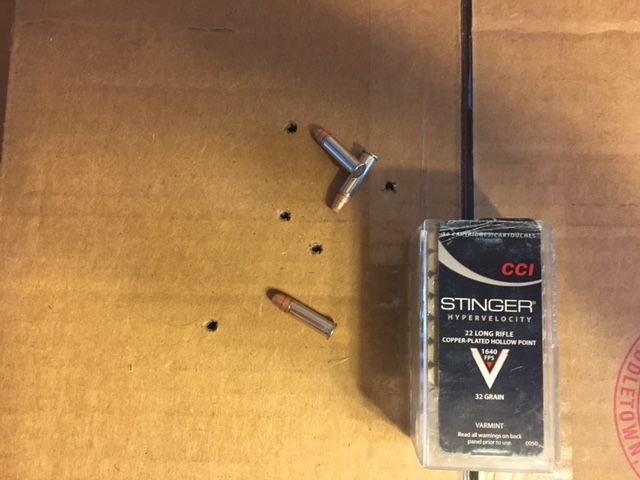
As you can clearly see, the CCI punched nice clean round holes through the cardboard. The Aguila punched oblong holes and looks like the bullets were impacting sideways...because that's exactly what they did. No wonder those grouse were so torn up, they had a spinning 60 grain, 0.224"x 0.625" cylinder of lead smashing through them. While the effect was deadly, an unstable bullet gives lousy accuracy. If those grouse had been in a higher tree or simply further away, I might have missed completely despite being within "gimme" range with an accurate .22 rifle. While my test wasn't geared for accuracy- the group size was three times that of the CCI Stinger and that bullet is pretty mediocre in my rifle. (Authors note- the test was simply firing offhand while freezing in the arctic air. No commentary on my shooting, I was simply looking for impact marks.)
My CZ has a barrel that is 25" long, well over the suggested length by Aguila. I attempted to conduct the same test with my Ruger Bearcat revolver and after 5 shots, hadn't managed to even hit the target. Since it was -11F, I assumed the accuracy is so dismal from a handgun that it was pointless to keep shooting until I hit one by luck. My CZ (and most other .22s on the market) have a barrel twist of 1 turn in 16". That's been the standard twist rate on .22s for just about forever and is completely adequate for virtually every variety of .22 ammunition out there...except this one apparently.
I must confess. At this point, I'm not even sure what this ammunition is good for. I suppose a person could have a .22 LR barrel fabricated with a faster twist, perhaps to use this ammunition with a suppressor, but you'd have a spendy, purpose built gun to use with a single variety of ammunition. Some rifles may in fact stabilize this ammunition, but I would certainly suggest you try it first before you lay in a large supply. It looks neat, and for close range work it did suffice with tremendous result, but nothing you could rely on at any reasonable distance.
It's an interesting concept, but at this point I'm inclined to regard it as a novelty.
Saturday, December 3, 2016
The Practical Hunting Battery- Revisited
It's cold outside, time to get back to blogging a bit. I've had a very busy fall season.
Back in the way back when, circa 2009, I wrote a piece about the minimum practical hunting battery. It's been one of the most viewed articles I've posted. That was eight years ago and my hunting has changed a little since then as well as some new things on the market and other market forces are at work.
The Big Game Rifle- The centerfire hunting rifle is the centerpiece of most folks hunting battery over much of the west as well as the rest of the country. While folks continue to attempt to press the AR platform into the big game rifle role, what we're really talking about here is a scoped bolt action. New rifles are lighter and more accurate than ever. Something on the order of a .30-06 or .300WM is probably about right. I've experimented with quite a few cartridges since I wrote that first piece and came away unimpressed with several. I've shot game with the 7-08, .270, .338WM and two flavors of .375. For an "all around" rifle in Alaska, the .300 or '06 makes a sensible choice. My current favorite rifle, a Nosler 48 in .300WSM has performed splendidly on a number of animals up to, and including, moose. A rifle in the finished weight of 7.5-8.5 pounds is about right for the balance between portable and shootable. In deer country, the 7-08 would be better than fine and it's my preference over the .270 Winchester. With modern bullets, the .338 and .375s are just much more than you need for the bulk of N.American hunting. A good bolt action with a decent scope in '06 or .300 is all you really need.
I've largely abandoned cartridges larger than that. My frequent hunting partner has made some great shots with his .338 as well as his .375 H&H. It worked, but there is only one degree of dead. I'm impressed with modern bullets and powders more and more and think that until game gets very large, the .30 cal is more than capable. I tipped over a bull moose this year with my .300WSM at a lasered 360 yards. Not sure more gun would have really helped much. I've done a lot of hunting with the .308, the .30-06 and the .300 and never really regretted it. In the Lower 48, a hunter could easily get by with the .270 or 7-08 and never come up under gunned.
The Rimfire - Market forces, being what they are, have largely seen the availability of .22LR vanish for much of the previous 7 years in a lot of the country and in my location- I went 4 or 5 years without seeing a single box on the shelf. I was a huge fan of the .22LR. Not so much now. What the intervening years did was turn me into much more of a shotgunner. I still have a pretty nice .22 rifle, but I seldom shoot it for anything other than the off grouse or marauding squirrel. The bulk of my small game hunting is now done with a shotgun. I've also taken up water fowling since the original article was written. I think the rimfire still has a place in most folks' hunting arsenal but non-exisant and more spendy ammunition took the luster off of it for me. My current .22 is a CZ 452 Trainer with a nice set of iron sights.
I'm not sure that the .22LR market will ever truly recover to a state I recognize, but if I were picking a rimfire today to go forth and shoot small game and get in some low cost practice- I'd go to the .17HMR and never look back.
The Shotgun- I took up shotgunning a few years ago when I picked up a Benelli M2. I kinda messed around with it some but the utter lack of .22 ammunition really got me going. I really think if a hunter is going to have one shotgun to do it all- a self loading 12 gauge with a 3" chamber has much to recommend to it. It's overkill for the majority of grouse hunting, except spooky sharp tails in open country, but it's perfect for ducks and geese. You could try to get by on waterfowl with a 20 gauge, but that's mostly a waste of time in the era of steel shot. I even picked up an 18" barrel for it to keep in camp.
Once you start exploring some of the offering with shotgun ammunition- things get interesting. I've even taken mine predator calling- loaded with Heavy-Shot "Dead Coyote" ammunition. I've enjoyed using the shotgun more and could easily see my way to a whole rack of them- but if I had to pick one, a 12 ga. 3" auto is it.
On that note. The construction of that self loading shotgun matters too. After messing with some gas operated guns- the kick a fair bit less but they weigh a lot more and seem pretty fussy. The Benelli Inertia system is now being copied by several makers and it flat out works well and isn't overly heavy or complicated. If I were shopping for a new shotgun- Inertia drive would be where I started.
The Extra-
I've tried a bit of this and that over the last few years. An air gun was pretty neat and I've done some good hunting with it. I've also gotten into archery, great fun but I haven't pursued big game with it yet. I've used some antique shotguns as something of an aesthetic pursuit. Though, at the end of the day- those three guns are what i reach for when I head out and I'm pretty confident I could use those three pieces for 99% of any hunting I'd do.
Back in the way back when, circa 2009, I wrote a piece about the minimum practical hunting battery. It's been one of the most viewed articles I've posted. That was eight years ago and my hunting has changed a little since then as well as some new things on the market and other market forces are at work.
The Big Game Rifle- The centerfire hunting rifle is the centerpiece of most folks hunting battery over much of the west as well as the rest of the country. While folks continue to attempt to press the AR platform into the big game rifle role, what we're really talking about here is a scoped bolt action. New rifles are lighter and more accurate than ever. Something on the order of a .30-06 or .300WM is probably about right. I've experimented with quite a few cartridges since I wrote that first piece and came away unimpressed with several. I've shot game with the 7-08, .270, .338WM and two flavors of .375. For an "all around" rifle in Alaska, the .300 or '06 makes a sensible choice. My current favorite rifle, a Nosler 48 in .300WSM has performed splendidly on a number of animals up to, and including, moose. A rifle in the finished weight of 7.5-8.5 pounds is about right for the balance between portable and shootable. In deer country, the 7-08 would be better than fine and it's my preference over the .270 Winchester. With modern bullets, the .338 and .375s are just much more than you need for the bulk of N.American hunting. A good bolt action with a decent scope in '06 or .300 is all you really need.
I've largely abandoned cartridges larger than that. My frequent hunting partner has made some great shots with his .338 as well as his .375 H&H. It worked, but there is only one degree of dead. I'm impressed with modern bullets and powders more and more and think that until game gets very large, the .30 cal is more than capable. I tipped over a bull moose this year with my .300WSM at a lasered 360 yards. Not sure more gun would have really helped much. I've done a lot of hunting with the .308, the .30-06 and the .300 and never really regretted it. In the Lower 48, a hunter could easily get by with the .270 or 7-08 and never come up under gunned.
The Rimfire - Market forces, being what they are, have largely seen the availability of .22LR vanish for much of the previous 7 years in a lot of the country and in my location- I went 4 or 5 years without seeing a single box on the shelf. I was a huge fan of the .22LR. Not so much now. What the intervening years did was turn me into much more of a shotgunner. I still have a pretty nice .22 rifle, but I seldom shoot it for anything other than the off grouse or marauding squirrel. The bulk of my small game hunting is now done with a shotgun. I've also taken up water fowling since the original article was written. I think the rimfire still has a place in most folks' hunting arsenal but non-exisant and more spendy ammunition took the luster off of it for me. My current .22 is a CZ 452 Trainer with a nice set of iron sights.
I'm not sure that the .22LR market will ever truly recover to a state I recognize, but if I were picking a rimfire today to go forth and shoot small game and get in some low cost practice- I'd go to the .17HMR and never look back.
The Shotgun- I took up shotgunning a few years ago when I picked up a Benelli M2. I kinda messed around with it some but the utter lack of .22 ammunition really got me going. I really think if a hunter is going to have one shotgun to do it all- a self loading 12 gauge with a 3" chamber has much to recommend to it. It's overkill for the majority of grouse hunting, except spooky sharp tails in open country, but it's perfect for ducks and geese. You could try to get by on waterfowl with a 20 gauge, but that's mostly a waste of time in the era of steel shot. I even picked up an 18" barrel for it to keep in camp.
Once you start exploring some of the offering with shotgun ammunition- things get interesting. I've even taken mine predator calling- loaded with Heavy-Shot "Dead Coyote" ammunition. I've enjoyed using the shotgun more and could easily see my way to a whole rack of them- but if I had to pick one, a 12 ga. 3" auto is it.
On that note. The construction of that self loading shotgun matters too. After messing with some gas operated guns- the kick a fair bit less but they weigh a lot more and seem pretty fussy. The Benelli Inertia system is now being copied by several makers and it flat out works well and isn't overly heavy or complicated. If I were shopping for a new shotgun- Inertia drive would be where I started.
The Extra-
I've tried a bit of this and that over the last few years. An air gun was pretty neat and I've done some good hunting with it. I've also gotten into archery, great fun but I haven't pursued big game with it yet. I've used some antique shotguns as something of an aesthetic pursuit. Though, at the end of the day- those three guns are what i reach for when I head out and I'm pretty confident I could use those three pieces for 99% of any hunting I'd do.
Saturday, June 18, 2016
Youth Shotguns...Too Little, Too Late.
I got into some different correspondence today...specifically about starting off a youngster with a shotgun. The question was, "What .410 is best to start a kid with?".
The answer: "There isn't one."
It seems a time honored tradition that you start a young hunter out with the diminutive .410 shotgun. In days past it was typically a single but pumps and even a couple of autoloaders have been manufactured. The rationale behind the choice is that the light recoil will encourage better shooting. If it were a rifle, I'd agree. But it's a shotgun, so I don't. Not at all.
Here goes the long winded explanation. The shotgun kills with pellets. The number of pellets gives you pattern density. Pattern density dictates how far away you can kill stuff. Simple? Not really. The typical .410 load of #7.5 shot is 1/2 to 11/16 ounces. The typical 20 gauge is firing 7/8 to 1 and 1/4 ounces of shot. That's 175-241(.410) compared to 306-437 (20 gauge) individual pellets in an individual shell. Considering it only takes one lethal pellet to kill... the 20 gauge is clearly a more powerful and lethal round. Hands down, no way around it. The 20 gauge will fire more pellets, have higher pattern density and be lethal at a longer range and be way more forgiving.
What about recoil? The .410 firing a 3" load in a 5.5 gun generates 10 ft/lbs of recoil force compared to 16 ft lbs for a light field load in a 20 ga. Is that significant? Maybe if you have your kid shooting 12 rounds of trap every day but for the average kid getting to blast a box periodically and maybe go shoot a grouse or some rabbits... it amounts to nothing. Any kid old enough to carry a lethal gun can stand up to 16 ft/lbs of recoil force, which is roughly equivalent to the 7-08 in a light rifle. There are a number of light loads available and a slightly heavier 20 gauge is going to have less felt recoil than a light .410 gauge.
My first shotgun? A .410. My kid's first shotgun? A .410. The wrong choice on both counts. A generational bad decision that keeps propagating.
My early attempts on squirrels with an ancient, hand me down .410 were abysmal and I quickly learned I was far deadlier with a .22 to much further than the .410 could be counted on. My son's results were much the same- after he let fly at a rabbit at a mere 20 yards and the rabbit ran off he was dejected. Dirt flew up all around the rabbit but he never left a drop of blood. He was simply in a hole in the pattern of the feeble payload. A 20 gauge would have provided one dead rabbit. It was shortly after this affair that I outfitted my son with a small frame 20 gauge pump and his lethality in the field went from zero to 100% in a single season. He took squirrels, hares, grouse, ptarmigan and loved that if he could get within thirty yards- he could seal the deal. He never made a comment about the recoil either. I've long held that recoil is only felt at the range. On game, I can't recall anyone ever talking about recoil- even at stout levels.
The .410 is very pleasant to fire, but lacks the killing power to give kids a good chance on game. I feel you're better off letting them feel some thump and give them some field success than playing softball on recoil and giving them a lot of frustration in the field. I think as a community we get this wrong all the time.
So what good is the .410? The .410 is a wonderful little cartridge and can make a wonderful light shotgun in the hands of a pro that points like a magic wand. In the hands of a kid it's a frustration, in the hands of an old master- it's a joy. The light gun weight and low recoil make shooting pleasant and the lack of pellets provide the level of challenge that many accomplished folks crave. Kids are still learning the basics and nothing like field success encourages more practice.
The .410 is widely promoted as ideal for beginners and that's all wrong in my book. We should be promoting it to the masters, right alongside the 28 gauge.
For a kid- the 20 gauge firing light loads is where it's at.
Sunday, May 15, 2016
The .308 Winchester....or Mr. Big Enough

On the other hand, I'm pretty plugged into the Alaska hunting community and am friends with a large number of very successful hunters. I was treated to a photo last week of a couple of friends of mine- a married couple- who explore much of Alaska and hunt extensively. The photo was from their spring bear hunt on Kodiak Island chasing the island's world famous brown bears. I'll not spoil the story should they ever decide to tell it and, besides, this story is about the .308 Winchester. Suffice to say the archetypical animal that inspires thousands to purchase true elephant guns in their pursuit fell to a single broadside shot from a .308 Winchester. And this couple are not just some lucky fools who happened to make it work once. They hunt bears, goats, sheep, moose, caribou and everything else on a near constant basis. Hubby is something of a rifle crank like I am but the wife is a "dyed in the wool" fan of the .308 in her bobbed Kimber Montana. It's the rifle she shoots the most, shoots the best and has bagged about one or five of everything there is to shoot here. Including now, a nine and one-half foot Kodiak bear...on the heels a 62" moose a couple years ago and a mountain goat last year.
Putting the 180 grain bullet at a plodding 2600 feet per second where it goes is much more important that a heavier bullet or a faster bullet. The fact that the world's most popular hunting cartridge is now the .308 isn't likely an accident either although worldwide acceptance isn't a wholly deciding factor alone- look at the AK47...easily the most common rifle on the planet with little to recommend it.
I'll digress....
I've had a very long association with the .308 and have taken a sizable number of animals with it, including my nicest caribou- a true old giant of a beast as far as caribou go. I wandered away from the .308 some time back, partially out of sheer boredom but I could easily go back to it as an all around rifle. I would do so with total confidence too. I've had .308s from Remington, Kimber, Winchester and of course, my Steyr. There's nothing I wouldn't hunt in Alaska with any of them. I handled a wonderful Sako Carbonlight a few months back and while the price tag could induce a coronary....I could happily hunt with it until the end of my hunting career and never look back.
There are plenty of old gun hands who dismiss the .308 as "inferior" or "weak" or any other such nonsense claims. Reading some of the older writers, they claim it's only good for Girl Scouts or to cycle through the M14 shooting diminutive Communists in some far off land. It was poppycock then and it still is.
I'll not bore the reader with the tale of the .308- that history is well documented- but we'd do well to remember that the ballistics that made the storied reputation of the .30-06 are exactly the ballistics offered in modern .308 ammunition. A 150gr at 2800, a 165 at 2700 and a 180gr at 2600. Modern .30-06 ammunition will typically get about an additional 100 feet per second added to those figures in sporter length barrels. It's my experience that those 100 fps do exactly nothing in terms of greater wounding or trajectory over typical distances. The bonus is that the .308 is available in some really great rifles- of particular interest are the super light rifles and carbines like those from Kimber and Sako. There is not a real advantage in picking the .308 in a 9 pound rifle.
However, a 6 pound rifle is a completely different matter and a short action will typically drop 6-8 oz from the weight of the action. It's no trick to get a hunting ready rifle in .308 under 7 pounds and not unusual to get under 6 pounds. The .308 case is a model of efficiency and gets full ballistic potential from barrels as short as 20". A svelte little carbine like the Sako Finnlight or Kimber Adirondack might give you a tangible advantage as you climb through 5000' or whack your way through some alder choked hell. That's a much more tangible thing to consider than some arbitrary numbers in a ballistic table.
We'd also do well to remember that while a certain level of power is desirable, ability to shoot proficiently is mandatory. Having cool nerves and utmost confidence in your ability will serve you better than the latest "uber magnum" headstamp. Knowing where to shoot something and that the bullet will hit what you aim at is far more important than any other factor in killing animals. There's a 9.5 foot Kodiak bear that learned that last week... and we should too.
Friday, March 25, 2016
The Contents of a Man’s Pockets...(a Rant)
(Author's note: this is the closest thing you'll get to men's fashion advice in this column...)
There seems to be a movement afoot wherein grown men become
very conscious about the contents of their pockets. The movement is called EDC,
which is an acronym for Every Day Carry. While I will wholeheartedly agree that
grown men typically have responsibilities that require the lugging about of
certain material goods, the movement has taken on an air of man-boy dress up. I
get that adult life can indeed take some very weird turns, and as a good Boy
Scout you should “Be Prepared”. Sometimes that train of thought can run on some
pretty bizarre tracks.
Case in point, in researching one of the many blogs
dedicated to EDC, readers of the blog take some sort of photo of their “EDC
Kit” and post it up for other readers to comment upon. One thing that struck
me, is that most of the photos had far more crap in them than most folks carry
on a daily basis. One sample had a full size 1911 handgun, a spare mag, a small
revolver, two flashlights, and (no kidding) three knives as well as one
multi-tool. I doubt very seriously any grown man packs that much crap on a
daily basis going about a workaday life- even a workaday life that might
involve physical violence. One thing curiously absent was a key ring. Given the
presumption that the poster was indeed a grown man, one would assume you’d have
some level of responsibility for managing a key of some sort. Close to 10
pounds of steel rummaging around in your pockets or belt and no key to a house,
car, office, etc. I call Walter Mitty on this one.
One of the things that also struck me strange is the
counterpoise to the entire EDC movement, which is The Minimalists. It is not unusual for these folks to not carry much at
all-no watch, no wedding band, only a tiny sliver of aluminum or leather that
holds a driver’s license and a couple of credit cards. No cash, certainly
nothing in the way of a firearm, no pocketknife. About the only thing for
certain is a giant, honking smart phone which might very well replace a full
sized computer in their home. It is as if any sort of material good is a
physical encumbrance that goes beyond what is acceptable. A wallet or watch
might slow them down or tax their stamina beyond the limit. I’ve even seen ads
for a new smartphone technology that eliminates the need for a credit or ATM
card- your phone can be used to get cash or pay for purchases directly. Sounds
like a complete disaster.
So here is my view from middle age in my not so humble
opinion on what every grown man ought to carry on a daily basis.
The required…
1.
Wallet- if you’re a grown man, you need a
wallet. Period. You’ll need to carry some form of ID, most likely an ATM and
credit card, insurance card, a photo of the family for the married man (or a
list of phone numbers for the bachelor). In my youth, I’d sure hate to trust
the number of a knock out redhead I just met to some digital ether. And
speaking of phone numbers, a grown man ought to have a business card or two in
there. Nothing fancy, but opportunity strikes when you least expect it. A
wallet also needs to be leather. A nylon number that closes with Velcro is fine
if you’re in junior high- adulthood is different. A well-made wallet can outlast you. A wallet
with a chain attached to your belt? Do I really need to go there?
2.
Cash- to go in that wallet. There is nothing
that points to adolescence like being financially naked. There is simply no
excuse for a grown man to be rolling around with just a couple of bucks. While
I’ll admit there is a practical limit here; a man should be able to buy a tire,
buy dinner, and buy a few groceries or a tank of gas without whipping out the plastic.
A surprising number of life’s minor disasters can be readily solved by the
application of a couple of Benjamins. Nothing says “adult” like paying the
dinner tab (and the tip) with a single bill of currency in the check and
walking out of the restaurant.
3.
Watch- a grown man is going to have some level
of responsibility. Part of that responsibility involves getting to places on
time. Punctuality is the basic level of respect you give other people- give it
and expect it from others. I know your dang phone has a clock on it, I get it;
but a man looking at his watch and a man looking at his phone portrays two very
different messages. I can subtlety (or not so subtlety) glance at my watch and
frown at some chatty Kathy to let them know that I value my time and have more
pressing matters to attend to. Looking at your phone just makes you one more of
zombiefied masses so common today.
And
speaking of a watch, it needs to do two things- tell the time and tell the date.
Gadgetry need not apply. Calculator watches were cool when you were a kid and
there is simply no need for a watch with an altimeter and GPS to keep you
moving smoothly through your day. A giant dive watch is only appropriate if
you’re a professional diver or a submarine captain (you’re neither so don’t).
The construction of a watch is also important. A jewel encrusted golden
monstrosity identifies you as a cheesy used car salesman or some other similar
over-compensator trying desperately to impress when you bring nothing of value
to the table. A plastic digital watch is practical and frugal- but as a man of
some means you get some leeway here- a stainless or titanium watch is always a
good move and appropriate everywhere in all situations. A good watch is an
investment, spend some of that hard earned money and you only need one. (Ladies,
a nice classic watch is the perfect gift).
4.
Jewelry. Unless we’re talking a wedding band,
don’t. Class rings, frat rings, etc. are a nice memento but have no place in an
adult wardrobe. In a similar vein, bracelets, chains, pinky rings, etc. make
you look like a complete douche. A man’s jewelry is a wedding band and a watch.
Period. And speaking of wedding bands- an appropriate wedding band is plain. A
woman’s engagement ring and wedding band is a sign of prowess and status. A
man’s wedding band is your wife marking her territory, no need for flash here.
Metal type isn’t particularly important; gold is traditional, platinum is
really too soft for a man’s ring and titanium and other exotic materials are
just fine and perhaps more practical. The newer “action bands” made of plastic
or silicon are tacky. If you’re engaged in high risk activities like sky
diving, MMA fighting or running a machine mill where a ring presents a hazard…just
take it off. Tattooed wedding bands? Just no.
5.
Pocket knife- carry a dang knife…you are not a
child. Unless you’re on a plane then you should have a knife in your pocket.
There is no need to go wild here. A knife is man’s first tool and contrary to
all the shrinking violets out there- a knife is a terrible weapon. As a grown
man you will undoubtedly have to open mail, open a box, cut a rope or some
other similar task that requires a blade. A giant knife is generally not
required, after all I’ve butchered a bull moose with a 3” folding knife and
bigger would have been a hindrance rather than a help. Multi-tools can be handy
but on most folks they look as nerdy as packing a shortwave radio. A good
quality knife says a lot about the man carrying it and the world is chock full
of perfectly acceptable ones. Oh, it should be sharp, a dull knife carries a
message too… a bad one.
6.
Key ring- as a grown up you likely have some
keys. You’re probably in a senior enough position to warrant a key to the
office or other workplace. You should have a key to the house or apartment.
Despite the proclivity of automakers to drift toward keyless cars, most of you
will need an automotive key, depending on locale- you’ll have a post office box
key. A simple key ring is fine. They’re keys, not a fashion statement. Needless
to say, you should avoid nonsense key fobs like fart noise makers and what not.
A functional key fob like an LED button light is totally ok. If your key ring
looks like you work at the county jail, you might need to rethink what you’re
packing around. Needless to say, a beer bottle opener on your key ring
identifies you as a juvenile who lacks either an imagination or a rudimentary
understanding of physics.
7.
Phone- adult life will almost certainly require
you to carry a phone in the modern era. Consider it a necessary evil or a minor
inconvenience at best. The zombie hordes run around all day staring into their
phones oblivious to everything around them. That’s stupid- while rare, if you
walk around in Condition White all the time someone might cut off your head and
put it on a stick. Be present where you are and for God’s sake, don’t look at
your stupid phone while being addressed by your superiors. It’s rude, and they
won’t forget it.
As an aside on the phone: Texting.
Texts are for limited communications… like “Can you pick up a gallon of milk?”
with the response of ”Will do.” That’s texting appropriately. If you need to
carry on a long discourse with several decision points just call them- you have
a phone in your hand after all. The younger generation seems to have forgotten
that phones are for talking. I’m in the minority here, but I hate texting. It’s
the lowest echelon of human communication.
The maybe….
8.
A pistol- lots of fluff on this one. Some folks
habitually carry a firearm and others do so vocationally. I’ve got no issue
with either provided it’s kept within the limits of reasonable. I’ve seen a
number of folks packing heat in the open; it’s legal here but it still makes
you look like a mouth breather man-boy playing livestock movement technicians
and indigenous peoples (unless you also happen to be wearing a uniform). A gun
is not a fashion or political statement, and anyone who tries to make one
either needs a serious butt kicking.
Packing heat should be a serious and discreet
activity for a lot of good reasons and that means concealed. That would favor
smaller weapons and given the popularity of concealed carry in the modern era,
makers produce a whole host of suitable pieces. A look at someone’s daily carry
gives you a good idea of their occupation, their level of paranoia, or more likely
their proclivity to fantasies about zombies and foreign invasions. Most of the
opinion on knives and watches translates here- too big is bad, too gadgety is
bad, too tiny is bad. If you find it required to pack a service pistol, a
reload and a smaller revolver on top of that I would suggest either a new job,
a shrink or a new zip code.
The “Just say no”….
There is a never ending list of
paraphernalia that folks carry around. I’ve seen tactical flashlights on a lot
of lists- could be handy in a given situation but most likely not in everyday
life. I’ve seen some pretty esoteric stuff too- like a 6” long titanium prybar.
I have to wonder how often a guy might suddenly need a prybar without warning
and if you did how well a 6” version would work. I’ve also seen a whole host of
miniaturized tools. As a guy who’s done a lot of mechanical work, substitutions
for actual tools usually just spell disaster in the form of busted knuckles and
stripped bolts. I know the appeal is that you’ll suddenly need a 10mm wrench
and your savvy preparations will save the day when you effect whatever repair
with a mini tool you just happened to have in your pocket. Truth be told,
you’ll spend $50 for a worthless titanium piece of stock with a 10mm EDM hole
in it that you’ll forget about every single time you need a 10mm wrench. It
will then live in the bottom of a drawer or your glove box forever.
I’m a wilderness guy and have a
whole kit of goods that I take there. On a lot of folk’s lists I saw a lot of
fire-making kits, compasses, small axes, and one guy claimed to EDC a breakdown
spear point. Given that most of these folks are straight up urban cube rats, I
find it hard to believe that on the way to the office they’ll suddenly need a
friction fire, a fresh cut sapling to make a fish spear and to navigate cross
country out of the blue. There’s prepared and then there’s out of touch with
reality.
To end my rant, I get that modern
life has stripped a lot out of masculinity. Being a man who makes his living
staring into an illuminated rectangle all day certainly doesn’t have a
satisfying snap like gunning down big game and roasting its flesh over an open
flame does. I even get that in today’s precarious times that the downward tug
of a pound and a half of stainless steel .45 automatic on your hip sure does
ease the apprehension about driving through certain parts of town. We’re men,
it is part of our ethos to be the prepared, to be the fixer, the problem
solver. For many of us, that’s a part of life that is sorely lacking. But
buying a whole bunch of bespoke gadgets to fill your pockets with won’t fill
the void, for that you need confidence and you earn that with callouses.
Tuesday, March 15, 2016
Snowmachines...more Dangerous than a Loaded Gun.
An interesting few days in the news regarding snow machines (snowmobiles for you Canadians and other illiterate types)...just kidding, snow machine is a fixed part of the Alaska lexicon, other places? Not so much.
But I digress-
In a widely circulated story- an intoxicated man hit two Iditarod teams in two seperate incidents over the weekend killing a dog and injuring three more. In another breaking story, husband of former Alaska governor Sarah Palin, Todd Palin, is in intensive care after being mangled by a snow machine over the weekend as well.
But those are just a couple of stories that achieved circulation due to the notoriety of those involved. Just about every week some anonymous Alaskan will strain a machine through the trees at high speed or ride one through a hole in the ice or simply get stranded out in the toolies..some of the worst off will trigger an avalanche. Some get rescued, some get medi-vaced, and some get buried. Some just never get found. The really stupid add booze to an already precarious situation.
Bottom line, snow machines as a mechanism of injury know few peers. Be careful out there folks.
Subscribe to:
Posts (Atom)